Use a single-appliance kWh reading to stop guessing at the bench

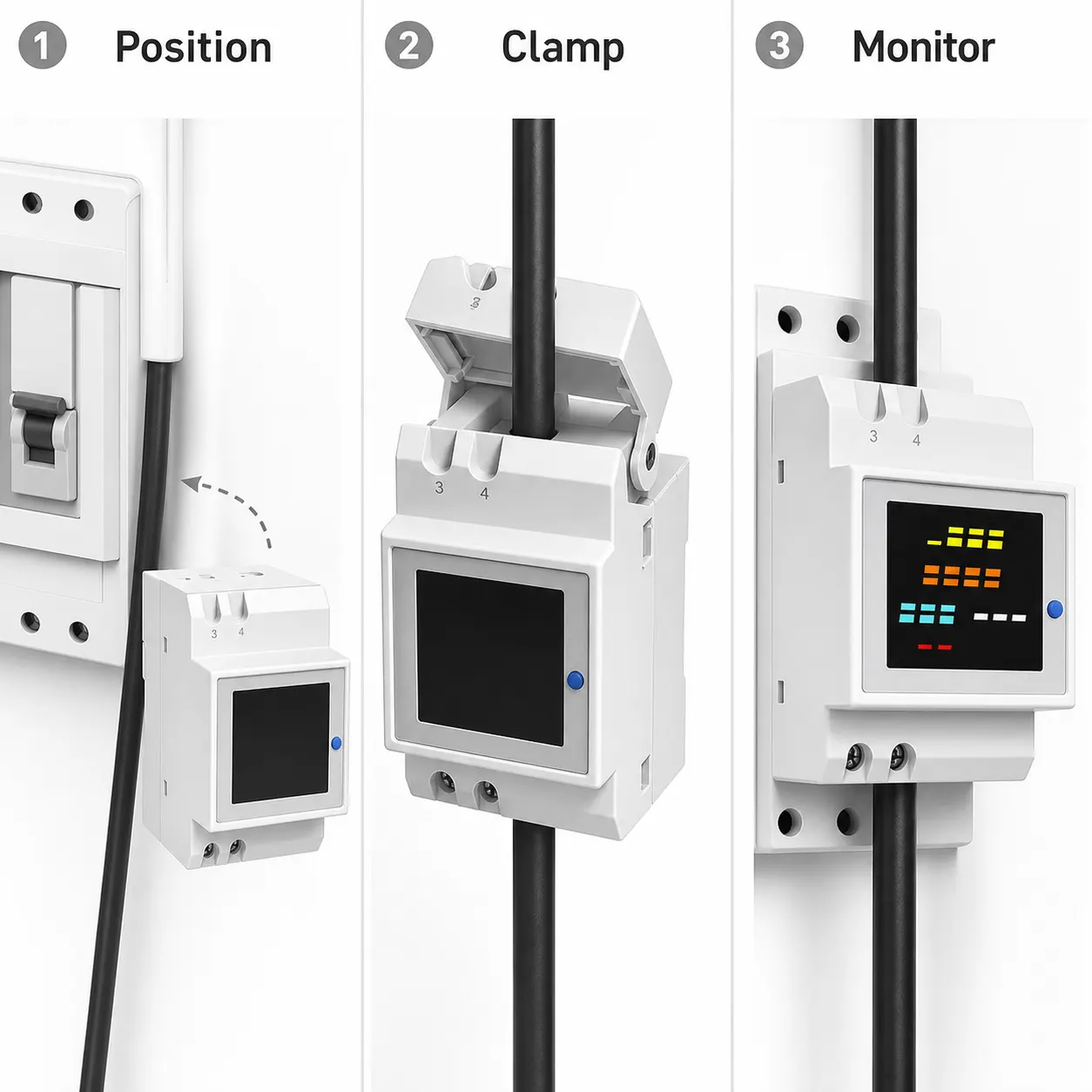
Product use sequence

A clamp kWh meter for single appliance is worth considering when the load you care about is not on a normal plug, or when a smart meter display only shows the whole property. For a garage workshop in Bristol, that might mean checking an immersion heater, fixed space heater, pump, tool circuit or outbuilding feed so you can see voltage, current, watts and accumulated kWh in one place. The immediate decision is simple: if you need one visible local display for one single-phase load, check the meter range, the current sensor arrangement and the installation setting before buying.

The HT-listed KETOTEK unit is described as a single-phase AC 40-300V, 100A DIN rail kWh meter with an external current sensor. Its display is presented as showing six measurements: voltage, current, electric power, energy, frequency and power factor. Those facts make it more relevant to a fixed circuit than a plug-in energy monitor, but they do not remove the need for competent electrical work. If the target appliance sits in a consumer unit, workshop distribution board or another enclosure with live wiring, the practical buyer’s question is not only whether the numbers are useful, but whether the fitting method is appropriate for the place.

Match the meter to a real UK workshop or outbuilding job

The clearest use case is a named load in a place where whole-home figures are too blunt. In a small Sheffield joinery workshop, for example, a owner may want to know whether a fixed heater is responsible for winter spikes, or whether a machine circuit is drawing more than expected during long jobs. A plug-in meter can help with kettle-style socket appliances, but it cannot answer questions about a hard-wired circuit. A CT-style meter with a local display is aimed at that gap: it gives a visible reading at the electrical point rather than relying on listed app summaries.

This kind of check is also useful in a mixed domestic and work setting, such as a garden room used as a home office, a pump in an outbuilding, or a fixed appliance in a utility area. The important point is to define the job narrowly. You are not trying to build a whole smart-home energy system, automate tariffs or diagnose every load in the property. You are trying to observe one appliance or one circuit well enough to decide whether to change a running pattern, investigate a fault, budget for replacement, or have a more informed conversation with an electrician.

Check the documented numbers before you assume it fits

Start with the facts that are actually documented. The product is listed for single-phase AC 40.0-300.0V, current AC 0-100.0A, electric power 0-30000W, energy 0-99999kWh, frequency 45.0Hz-65.0Hz, and power factor 0.00-1.00PF. Those are the core figures a buyer should compare against the intended circuit. If your appliance or circuit sits outside the stated single-phase context, or you are unsure what the circuit actually is, that uncertainty should be resolved before purchase or installation.

The display matters because the decision often depends on more than one number. Instant watts can show what is happening while the appliance is running, while kWh helps you understand consumption over time. Current can be useful for load awareness, and power factor helps avoid treating amps alone as the full energy story. The public information also says the energy value is saved when power is off and continues accumulating when measurement power is reconnected. That is useful for a workshop or outbuilding check where you want to come back later and read accumulated use, provided the installation is set up correctly.

Treat clamp placement and electrical access as the main safety boundary

The common buyer mistake is to focus on the word clamp and assume the whole job is casual DIY. A current sensor still has to be used in the correct electrical context, and the display itself is a DIN rail meter. In plain English, this is not the same kind of product as a socket energy monitor you plug into the wall. If the appliance circuit is inside a consumer unit, a workshop board or another mains enclosure, the fitting job crosses into electrical work where competence matters.

The product copy says that if used for three-phase power, only one live wire and neutral wire can be connected to measure. That wording should be treated carefully, not stretched into a promise that it will solve every three-phase or split-load scenario. For most UK buyers looking at one appliance, the safer mental model is this: define the single-phase circuit, make sure the sensor is around the intended conductor arrangement, and do not improvise around exposed wiring. If you are not already comfortable identifying the right circuit and enclosure conditions, the next practical step is to involve a qualified electrician.

Know when this is the wrong answer for the bill problem

A clamp-style kWh display is not always the right purchase. If the appliance has a normal 13A plug and you only need a quick check, a plug-in meter may be simpler. If you need whole-home graphs, remote app viewing, tariff automation or solar-battery optimisation, this product’s public facts do not describe those capabilities. It is a local display meter for electrical readings, not a complete energy management platform. Buying it for the wrong job can leave you with numbers that are real but not enough to answer your actual question.

It is also not a substitute for legal or tenancy advice. A landlord, workshop operator or property manager may want separate kWh visibility for a unit, outbuilding or tenant area, but the available product facts do not state billing-grade certification or legal suitability for resale charging. A visible kWh figure may support a transparent discussion about shared electricity, yet rules, listed costs, agreements and evidence still matter. If money will change hands based on readings, treat the device as monitoring hardware unless you have separate confirmation that the whole metering arrangement is suitable for that purpose.

Use this practical pre-buy checklist at the packing bench

Before you order, write the target load on paper in ordinary words: for example, ‘garage heater circuit’, ‘immersion heater’, ‘outbuilding pump’ or ‘workshop machine supply’. Then check six concrete points against the documented facts. One, is the target single-phase and within AC 40.0-300.0V? Two, is the expected current within AC 0-100.0A? Three, do you need accumulated kWh as well as instant watts? Four, is there a suitable DIN rail location or enclosure plan? Five, can the external current sensor be fitted correctly around the intended conductor? Six, are you competent to access the wiring, or should an electrician handle it?

After that, decide what reading will count as success. If your goal is to find whether the outbuilding heater is driving the bill, reset the energy value, run the appliance over a meaningful period, and compare the kWh shown with your expectations. If your goal is to understand a workshop circuit, watch watts and current while the load is operating, then use accumulated kWh for the longer view. If your goal is a landlord or tenant conversation, keep dated reading logs and be clear that a monitor reading is not the same thing as legal permission to charge.

Compare it with plug-in monitors and smart meter displays

A plug-in monitor is easiest when the appliance already plugs into a socket and the question is simple. It sits between the appliance and the wall socket, so it avoids the distribution-board fitting issue. Its weakness is equally clear: it cannot measure a hard-wired heater, an immersion circuit, a pump supply or another load that does not pass through a normal plug. For a single fixed appliance, that is where a DIN rail meter with an external current sensor becomes relevant, assuming the electrical setup is suitable.

A smart meter display answers a different question. It can show property-level use, which is useful for spotting a spike but poor at naming the appliance behind it. In a Manchester terrace with a workshop in the back room, the in-home display may rise when several things are on at once, but it will not isolate the fixed load you suspect. The KETOTEK-style display is more focused: voltage, current, watts, kWh, frequency and power factor for the measured circuit. That focus is helpful only if the chosen circuit truly represents the appliance or area you want to understand.

Take the next step without overcomplicating the project

For most buyers, the sensible next step is to define one measurement job and avoid turning it into a property-wide monitoring redesign. Choose the appliance or circuit, check the documented voltage and current ranges, confirm that a local DIN rail display makes sense, and decide who will install it. If the point of the exercise is bill investigation, plan a simple reading period: reset, run the load normally, note the kWh, and relate that to the behaviour you can change.

If the target is more complex, such as solar PV self-consumption, a heat-pump circuit, a mixed-use property or a tenant area, pause before assuming one meter gives the whole answer. The public product facts support local measurement of electrical values; they do not claim export accounting, app reporting, tariff control or certified billing use. Used with that boundary, a clamp kWh meter can be a practical way to make one hidden load visible. Used beyond that boundary, it risks answering a narrower question than the one you meant to ask.