
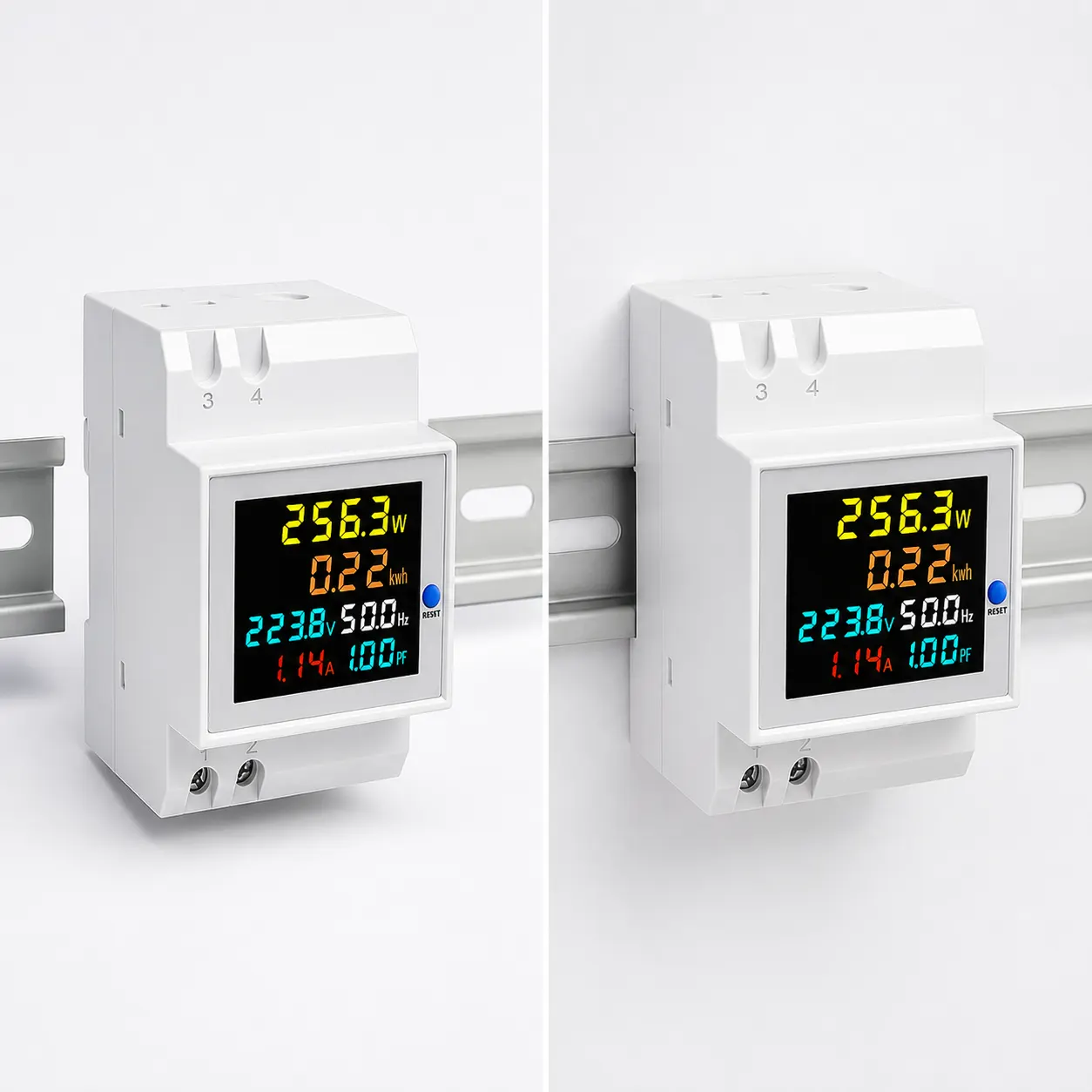
Short answer: A CT clamp energy monitor UK search should not be treated as proof that every listed energy meter includes the same current transformer or installation method. The product page names a single-phase energy meter and lists AC 40.0-300.0 V, AC 0-100.0 A, energy to 99999 kWh, 45-65 Hz and power factor 0.00-1.00. This version reads current with an external CT, to class 1 accuracy (1% ± 2 digits). Connect voltage to terminals 1 and 2 and the CT secondary to terminals 3 and 4. Compare the measurement question with those confirmed facts, then ask a competent person to resolve the installation boundary.
Treat CT as a question to verify
A current-transformer arrangement can be central to a clamp-monitoring design, and the product page does describe an external CT, class 1 accuracy, and terminals 1-2 for voltage and 3-4 for the CT secondary. The stated facts are class 1 accuracy and an external CT up to 100 A.
The page does describe a single-phase energy meter and gives the electrical values shown below. That supports a first-pass product comparison, a first look at this DIN-rail meter before a competent person checks the circuit.
| Displayed item | Current page evidence |
|---|---|
| Voltage | AC 40.0-300.0 V |
| Current | AC 0-100.0 A |
| Power and energy | energy 0-99999 kWh |
| Frequency and power factor | 45.0-65.0 Hz and 0.00-1.00 PF |
| CT construction and accuracy | Class 1, external CT, up to 100 A. |
What the product page does support
The listing provides a useful set of headline comparison values and says that the energy value is saved when power is disconnected and continues accumulating when measurement power is restored. It also describes a five-second reset action and a backlit display.
The stated accuracy is class 1, 1% ± 2 digits, with a refresh about twice a second. The colour LCD shows watts, kWh, volts, hertz, amps and power factor for this single-phase meter. Stay with the ranges published for the HT D52-2066.
Make the UK safety check first
HSE says electrical equipment must be suitable for the supply and task, and people carrying out electrical work need the competence appropriate to the job. That is especially relevant where a monitoring plan reaches a fixed circuit, enclosure or appliance connection.
- Describe the supply, phase arrangement, measurement point and expected current without opening the installation.
- Ask the manufacturer for the CT details, wiring diagram, insulation or safety category, accuracy and installation limits.
- Have a competent person check whether the proposed sensor placement and meter connection are suitable for the actual circuit.
- Stop the purchase or installation when a missing fact could change the electrical safety or measurement result.
Read the kWh figure on this meter
The kWh figure is the total this meter stores on its own screen. Accuracy is class 1. The meter keeps that total when the supply is off and continues when power returns. It is safer to describe the item as a meter with the listed display ranges than as a certified energy-accounting instrument.
The same restraint applies to compatibility. This version is single phase, AC 40-300 V, with one external CT up to 100 A. Confirm the exact use case before ordering.
Related guides and product details
Use the product page as a shortlist source for the published ranges, then verify the CT and installation details with the manufacturer and the competent person responsible for the circuit. Read Clamp kWh Meter for a Single Appliance: UK Checks for related guidance. Read Clamp Power Monitor for a Hard-Wired Appliance for related guidance. Review the documented specification on the HT D52-2066 DIN-rail energy meter, AC 40-300 V, external CT product page before ordering.
Sources and safety context
- Supports the single-phase product description, display ranges, reset and energy-value saving statements. HT D52-2066 product page.
- Supports checking the supply and equipment suitability. HSE: Work using electrically powered equipment.
- Supports competence and safe planning boundaries. HSE: Work on electrical equipment, machinery or installations.
- Supports the UK legal context for electrical work. Electricity at Work Regulations 1989.